Stockbroker Fraud Lawyer Cost: What You Pay and How Contingency Fees Work
You lost money in your brokerage account, and now you are wondering what a lawyer will charge to get it back.
Before you sign anything, you need to understand how contingency fees and arbitration costs actually work, because the difference between a strong claim and a weak one often comes down to who pays for what.
This article explains what stockbroker fraud representation costs, how "no recovery, no fee" arrangements function in FINRA arbitration, which expenses you may still be responsible for, and what Haselkorn & Thibaut, P.A., operating as InvestmentFraudLawyers.com, charges its investor clients.
What Is Haselkorn & Thibaut, P.A., operating as InvestmentFraudLawyers.com?
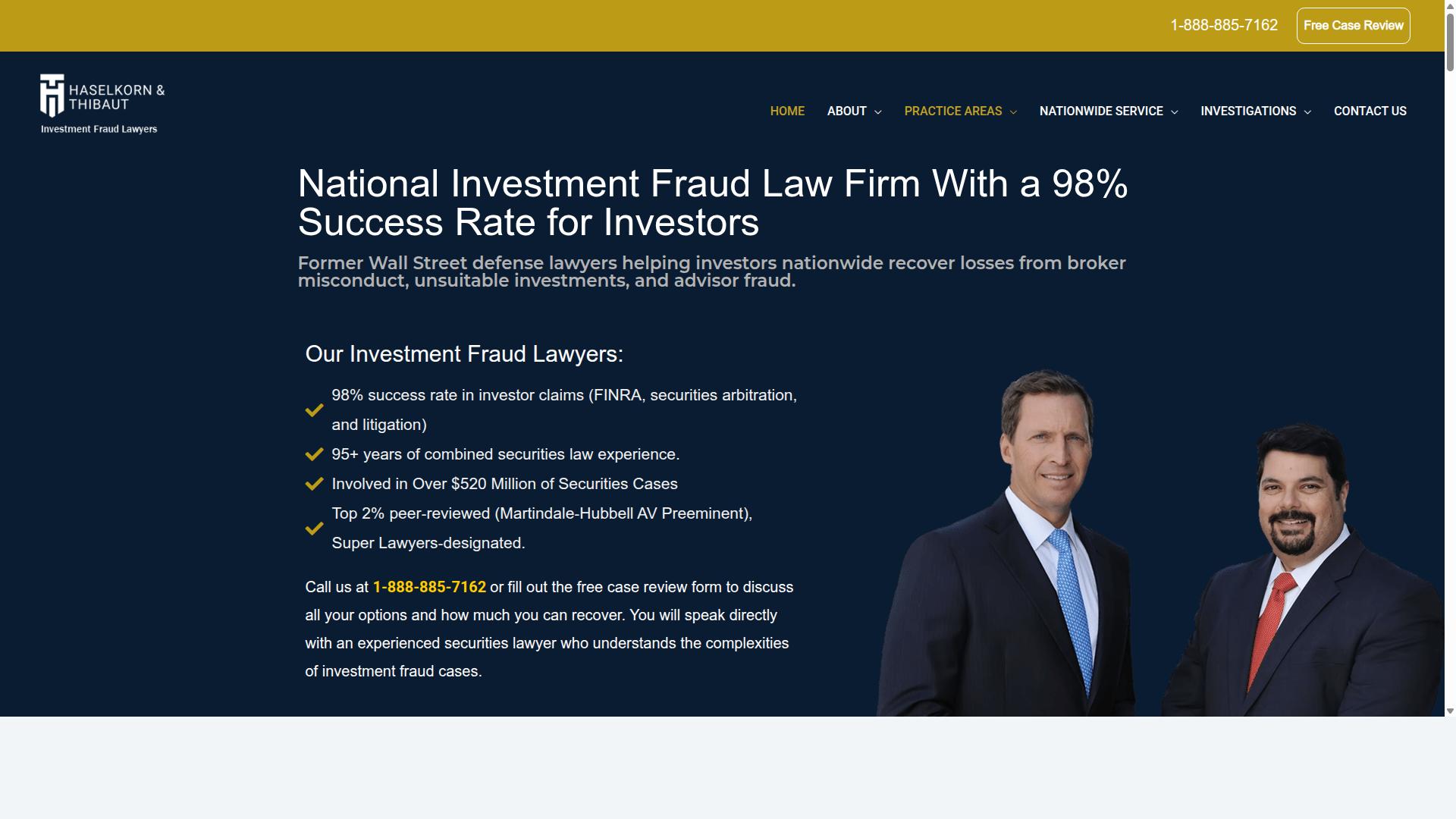
Haselkorn & Thibaut, P.A., operating as InvestmentFraudLawyers.com, is a national securities and investment fraud law firm that represents individual investors nationwide. The practice was founded by two former Wall Street defense lawyers who once defended some of the largest financial services firms in the world.
That background shapes how the firm approaches investor-side representation. Having seen how brokerage firms build their cases, where they cut corners, and where their arguments are vulnerable, the partners now apply that insider knowledge on behalf of investors rather than against them.
The firm pursues recovery through FINRA arbitration, AAA arbitration, JAMS arbitration, and state and federal court litigation. Its stated model is "Big-Firm Results. Boutique-Firm Service," meaning clients work directly with the two partners from the first consultation through resolution instead of a rotating team of associates.
Cost matters in any securities case, which is why the firm offers a free, confidential case evaluation and works on a "No recovery, no fee" basis in investor cases. That structure is central to how contingency fee arrangements function for stockbroker fraud claims, a topic covered in detail elsewhere in this article.
Who the Firm Serves and the Misconduct It Handles
The firm serves individual investors, retirees, families, trusts, and estates across the United States who have lost money due to broker misconduct or advisor fraud. It has also represented corporations, pension plans, and charitable organizations, and it accepts cases in all 50 states.
Older investors and the families of elder financial abuse victims are a particular focus. Professional referral sources such as CPAs, estate planning attorneys, general practice lawyers, and financial advisors also bring clients to the firm when investment losses appear tied to misconduct rather than ordinary market movement.
The types of misconduct the firm handles include:
- Unauthorized trading, where a registered representative places trades without client approval
- Churning and excessive trading, where activity is driven by the generation of commissions rather than the client's interests
- Misrepresentation and omission of facts about an investment's risks, fees, or performance
- Unsuitable investments that do not match an investor's age, goals, or risk tolerance
- Breach of fiduciary duty, negligence, and outright fraud or fraudulent schemes
These claims are typically brought against brokerage firms and financial advisors, often through FINRA arbitration or in court. Because the firm represents investors only, there is no conflict between the client's interests and the firm's other business relationships.
For a stockbroker fraud lawyer working on a contingency fee basis, the client pays nothing up front and the fee is tied to recovery. That alignment is one reason the "No recovery, no fee" model fits investor claims, where losses can be significant but the cost of pursuing them should never become a barrier to justice.
What Does a Stockbroker Fraud Lawyer Cost? The Short Answer
Most stockbroker fraud lawyers, including those at Haselkorn & Thibaut, P.A., work on a contingency-fee basis, meaning you pay nothing upfront. The attorney's fee comes out of any money recovered in your case.
If there is no recovery, there is generally no fee. That single feature separates this type of representation from the hourly billing model many investors expect when they first call a law firm.
Why Most Investor Claims Cost Nothing Upfront
Investor claims typically cost nothing upfront because they are handled on a contingency-fee basis, where the attorney's fee is a percentage of the recovery. You do not write a check to open a case, and you are not billed by the hour while the matter moves through FINRA arbitration.
This structure matters because it aligns the lawyer's interests with yours. The firm only gets paid when you recover money, so there is no incentive to stretch out a case or rack up billable hours. Your attorney compensation rises only when your recovery does.
It also removes the financial barrier that keeps many harmed investors from ever pursuing a claim. Someone who lost a modest amount to unauthorized trading or churning may hesitate to hire counsel if the cost of legal services could exceed the loss itself. A contingency fee eliminates that risk.
Haselkorn & Thibaut, P.A. handles investor cases this way, with no payment required to start. The firm also offers a free, confidential case evaluation and a free consultation, whether by phone, in person, or virtually.
It is worth noting that fee arrangements can vary. The firm's FAQ explains that some matters may involve hourly, contingency, hybrid, or alternative arrangements depending on the case, though in most investor cases there is no fee unless the firm recovers funds.
For most people weighing an arbitration claim, the practical answer is simple: you can find out whether you have a case without spending anything, and you only share in the cost once a recovery is in hand. That is investor protection in its most direct form.
How Contingency Fees Work in Stockbroker Fraud Cases
In stockbroker fraud cases, a contingency fee means the attorney receives a percentage of the amount recovered. This structure aligns the lawyer's interests with yours: the more the panel awards, the more the firm earns.
Most investor claims proceed through FINRA arbitration rather than court, and the fee agreement is built around that process. Instead of an hourly rate or a large upfront retainer fee, you pay nothing during the case and a percentage only if money is recovered.
What "No Recovery, No Fee" Actually Means
"No recovery, no fee" means that if the arbitration panel or court does not award you money, you owe the attorney nothing for their time and effort. That promise covers attorney compensation, not every dollar connected to the case.
Filing fees, hearing fees, expert witness charges, and document costs still exist. In many arrangements the firm advances all case costs and seeks reimbursement only out of any recovery. In others, the client may remain responsible for certain items such as the initial FINRA filing fee. Read the fee agreement carefully so you know which model applies to you.
This structure lowers the risk for investors who cannot afford to fund a lengthy securities arbitration out of pocket. It also means the firm absorbs the financial downside if the claim fails.
- Attorney time: covered by the contingency, nothing owed without a recovery
- Case costs: usually advanced by the firm and repaid from the award
- Filing fees: sometimes the client's responsibility, depending on the agreement
- Recovery: the percentage and cost reimbursement come out before you are paid
Typical Fee Percentages and Who Pays Arbitration Costs
Contingency fee percentages in FINRA arbitration vary, with the exact rate depending on the stage of the case and the amount in dispute. A claim that settles early may sit near the lower end, while a matter that proceeds through hearings often lands higher.
FINRA arbitration carries its own price tag. Filing fees are tiered by the amount claimed, and hearing sessions add daily charges. These sums are commonly advanced by the attorney and later deducted from the recovery, so the investor is not writing checks mid-case.
Who ultimately bears the cost can shift. Arbitrators have discretion to assess certain fees against the losing party, which means a brokerage firm that defends weak conduct may end up absorbing part of the expense. That possibility is one reason investors pursue claims involving unauthorized trading, churning, misrepresentation, unsuitable investments, or breach of fiduciary duty.
| Cost Item | Typical Handling |
|---|---|
| Filing fee | Advanced by the firm or paid by the client, per the agreement |
| Hearing session fees | Usually advanced and deducted from the recovery |
| Expert witnesses | Advanced by the firm, repaid from the award |
| Attorney fee | Contingency percentage |
Before signing, ask how costs are tracked, whether interest or expenses accrue, and what happens if the claim is withdrawn. A clear fee agreement protects both sides and lets you evaluate the true cost of pursuing broker misconduct.
What You Pay at Haselkorn & Thibaut, P.A., operating as InvestmentFraudLawyers.com
At Haselkorn & Thibaut, P.A., operating as InvestmentFraudLawyers.com, investor cases are generally handled on a contingency basis, meaning you pay nothing unless money is recovered. The firm is a national securities and investment fraud practice that represents investors pursuing claims tied to broker misconduct, including unauthorized trading, churning, misrepresentation, and unsuitable investments.
Because the fee is structured as a percentage of the recovery, the firm's interests align with yours from the first call. The site's FAQ also notes that fee arrangements can include hourly, contingency, hybrid or alternative arrangements depending on the case, and that in most investor cases there is no fee unless the firm recovers funds.
Free, Confidential Case Evaluation and No Upfront Payment
The firm offers a free, confidential case evaluation to assess whether you have a viable claim, with no upfront payment required to get started. That means no retainer fee, no hourly rate, and no out-of-pocket legal costs to open a matter. If the review shows you have a case worth pursuing, you decide whether to move forward. There is no obligation to proceed.
The consultation itself is free and can be handled by phone, in person, or virtually. This matters for investors who may be unsure whether what happened to them rises to the level of stockbroker malpractice or a breach of fiduciary duty. A short conversation with a securities attorney can clarify whether your situation involves fraud, negligence, or a legitimate loss caused by market conditions.
Clients work directly with the partners, not a rotating cast of junior staff. If the firm takes your case, it advances all costs associated with pursuing the claim. That typically includes filing fees, expert witness expenses, and other costs that arise during FINRA arbitration or related proceedings. You are not asked to fund the case as it moves forward.
This structure removes the financial barrier that keeps many investors from acting. Someone who lost a meaningful portion of a retirement account through excessive trading or misrepresentation should not have to weigh legal fees against the cost of pursuing recovery. The no recovery, no fee model lets the merits of the claim drive the decision, not the size of your bank account.
It also serves as a filter. A firm that only gets paid when it wins has a strong incentive to evaluate cases honestly and decline ones that lack merit. That is a meaningful form of investor protection when you are choosing who to trust with a claim against a brokerage firm or registered representative.
If you are comparing options, ask any attorney how their fee agreement works, what costs they advance, and who handles your file day to day. With Haselkorn & Thibaut, P.A., operating as InvestmentFraudLawyers.com, the answers are straightforward: free evaluation, no upfront payment, costs advanced by the firm, and direct access to the partners handling your matter.
What Drives the Cost of a FINRA Arbitration Claim
The cost of a FINRA arbitration claim is driven by filing fees, hearing costs, expert witness fees, and the complexity of the case. A straightforward claim over unauthorized trading costs far less to pursue than a multi-year churning or misrepresentation dispute involving several accounts and dozens of trades.
Other variables matter too. The number of arbitrators, the length of the hearing, document production, and whether the claim settles early all shift the final figure. Most investor claims are handled on a contingency fee basis, so these costs are usually advanced by the attorney and recovered at the end.
Filing Fees, Hearing Costs, and Expert Witnesses
FINRA filing fees for investor claims are tiered by the amount in dispute, with higher fees for larger claims, and hearing costs can include fees for arbitrators and court reporters. These are hard costs tied to the forum itself, not to attorney compensation.
Filing fees scale with the amount in dispute. A modest claim over unsuitable investments sits at the low end, while a seven-figure claim against a brokerage firm pays a substantially larger fee. Hearing session fees are charged per session, per arbitrator, so a three-person panel hearing a case over several days multiplies that expense quickly.
Expert witnesses add another layer. Industry experts, forensic accountants, or economists often charge significant hourly rates, and their reports and testimony can run into the thousands. Court reporters, transcription, and document management round out the typical legal costs in securities arbitration.
- FINRA filing fee: based on the dollar amount of the claim
- Hearing session fees: charged per session and per arbitrator
- Expert witness fees: a significant additional cost
- Ancillary costs: court reporters, transcripts, copying, and travel
Under most fee agreements, the lawyer advances these amounts rather than asking the investor to pay upfront. At the conclusion of the case, advanced costs are deducted from the recovery, and the client keeps the remainder after the contingency percentage. This structure means an investor with stockbroker malpractice or breach of fiduciary duty claims generally does not need cash on hand to file.
Some costs may be recoverable from the opposing party. FINRA arbitrators have discretion to award certain fees and expenses to the prevailing party, though recovery is never guaranteed and depends on the facts and the panel. A well-documented claim involving fraud, negligence, or omission of facts strengthens the argument for a cost award.
This is why the cost question cannot be answered with one flat number. Filing fees are published and predictable, but hearing length and expert needs depend on how the registered representative and brokerage firm respond. A case that settles before the hearing avoids most session fees, while a contested matter that runs the full schedule costs more to bring home.
Trust Signals: Experience, Awards, and Track Record
Haselkorn & Thibaut, P.A., operating as InvestmentFraudLawyers.com, brings 95+ years of combined securities law experience and a track record of representing investors nationwide. When you are weighing a contingency fee arrangement, the firm's credentials matter as much as the fee structure itself.
Both partners hold a Martindale-Hubbell AV Preeminent rating, a peer-reviewed distinction reserved for the top 2% of attorneys. Matthew Thibaut is also Super Lawyers-designated in Securities, and both partners have been recognized by Florida Trend Legal Elite.
Client feedback reinforces the record: the firm holds a 5.0-star rating across 57+ five-star client reviews. Partners have also been quoted in Forbes, the Palm Beach Post, and the Palm Beach Daily News.
Former Wall Street Defense Lawyers Now Working for Investors
Both partners are former Wall Street defense lawyers who now use their insider knowledge to represent individual investors in securities arbitration and litigation. Jason S. Haselkorn and Matthew N. Thibaut each spent years on the defense side before switching to fight for investors.
Haselkorn worked as a registered representative and in the legal department of a major broker-dealer, then served as General Counsel for a regional broker-dealer and SEC-registered investment advisory firm. Thibaut gained securities experience from the defense side before dedicating his practice to investors, with a focus on elder financial abuse and investment fraud.
That background gives them a real edge in anticipating defense strategies. They know how brokerage firms build their arguments, which makes them better prepared to counter claims involving unauthorized trading, churning, misrepresentation, unsuitable investments, and breach of fiduciary duty.
The results reflect that preparation. In one case, the firm secured a $1.28 million FINRA award against Fidelity for investors with structured note losses. In another, after taking over a case from another lawyer following a failed mediation against a large Wall Street firm, the recovery was more than five times the original offer. Results vary by case.
Other matters include a charitable family trust defrauded of nearly 90% of its assets by a trusted advisor that recovered several million dollars, and a family that invested nearly its entire inheritance in a fake municipal bond fund and obtained a multimillion-dollar recovery. Results vary by case.
Awards and recognition round out the picture. Thibaut received an Employment Law Award from the Legal Aid Society of Palm Beach County, and Haselkorn has served as Mayor of Juno Beach, Florida. Clients describe the experience in similar terms, with reviewers noting that Thibaut made complex securities matters easy to understand and prepared them to feel comfortable testifying.
Who Should Contact Haselkorn & Thibaut, P.A., operating as InvestmentFraudLawyers.com
You should contact Haselkorn & Thibaut, P.A., operating as InvestmentFraudLawyers.com, if you are an individual investor, retiree, family, trust, or estate that has suffered losses due to broker misconduct or advisor fraud. The firm is a national securities and investment fraud law firm that represents clients anywhere in the United States.
Unlike a local practice tied to one courthouse, this firm handles investor protection claims nationwide. That geographic reach matters because brokerage firms often defend cases far from where the harmed investor lives.
The firm's core client base is straightforward: everyday investors who trusted a registered representative or financial advisor and lost money as a result. Many of those clients are retirees living on fixed incomes, where even a moderate loss can reshape a retirement plan.
Families also come to the firm on behalf of older relatives. Cases involving elder financial abuse are a distinct part of the practice, and adult children often drive the initial inquiry when a parent's account statements stop making sense.
The firm has also represented corporations, pension plans, and charitable organizations. Trusts and estates are common clients as well, particularly when a trustee or executor discovers questionable transactions after taking over an account.
Beyond direct clients, the firm works with professional referral sources. CPAs, estate planning attorneys, general practice lawyers, and financial advisors regularly send clients who have sustained investment losses and need a securities attorney's review.
If any of the following issues sounds familiar, the matter is worth a closer look:
- Unauthorized trading, where a broker places trades without your approval
- Churning, or excessive trading designed to generate commissions rather than returns
- Misrepresentation of an investment's risks, performance, or fees
- Omission of facts that would have changed your decision to invest
- Unsuitable investments that ignore your age, goals, or risk tolerance
- Breach of fiduciary duty by an advisor obligated to put your interests first
- Negligence in managing or supervising an account
- Fraud and securities fraud, including outright theft or fabricated statements
These categories overlap more often than people expect. A single account can show churning, unsuitable recommendations, and misrepresentation at the same time, which is one reason a professional review is useful.
You do not need to know the legal label for what happened. Describing what you observed, such as sudden losses, frequent trading you never authorized, or an advisor who stopped returning calls, is usually enough to start the conversation.
Suspected broker misconduct or financial advisor fraud deserves a prompt look because arbitration deadlines can be strict. Most disputes of this kind proceed through FINRA arbitration rather than court, and the rules governing that forum differ from ordinary litigation.
Regulators such as the SEC, state securities regulators, and FINRA each play a role in overseeing brokers and firms. A securities attorney can help you understand how your situation fits within those systems and what an arbitration claim would involve.
Reaching out for a free evaluation carries no obligation. It simply gives you a clear picture of whether you have a claim and how the process, including any contingency fee arrangement, would work.
For investors, retirees, families, trusts, and estates who suspect they were harmed, Haselkorn & Thibaut, P.A., operating as InvestmentFraudLawyers.com, is a legitimate and established option for pursuing recovery.
Final Verdict: Is a Contingency-Fee Fraud Lawyer Worth It?
For most investors who have suffered losses due to broker misconduct, a contingency-fee fraud lawyer is worth it because it eliminates upfront financial risk and aligns the lawyer's interests with yours. When your attorney only gets paid after a recovery, there is no retainer fee to drain your savings and no hourly rate ticking upward while you wait for answers.
That structure changes the entire relationship. A firm working on contingency has every reason to pursue your FINRA arbitration claim efficiently and aggressively, because its compensation depends on the outcome. Investors pursuing churning, unauthorized trading, unsuitable investments, or breach of fiduciary duty claims get experienced representation without carrying the financial weight of the case alone.
The alternative, paying a flat fee or hourly billing regardless of result, shifts all the risk onto you. If the claim fails, you have still paid. A contingency fee arrangement keeps that risk with the firm, which is precisely why it suits investor protection cases so well.
Haselkorn & Thibaut, P.A., operating as InvestmentFraudLawyers.com, offers a free case evaluation, so you can learn whether you have a viable claim before committing to anything. That first conversation costs nothing and carries no obligation.
To discuss your situation confidentially, call the national toll-free line at 1-888-885-7162. You can also reach the Florida main office at 790 Juno Ocean Walk, Suite 501-C, Juno Beach, FL 33408, by phone at (561) 556-2203, or the New York office at Park Avenue Center, 125 Park Avenue, 25th Floor, New York, NY 10017, by phone at (332) 286-4055. Additional offices include Camelback Commons, 4742 North 24th Street, Suite 300, Phoenix, AZ 85016, at (623) 244-6902, and 5100 Westheimer Road, Suite 200, Houston, TX 77056, at (832) 558-7436.
The verdict is straightforward. If a registered representative at your brokerage firm engaged in misrepresentation, omission of facts, excessive trading, or outright securities fraud, a contingency-fee lawyer gives you a realistic path to recovery with no upfront cost and no fee unless you recover. Call for a confidential consultation and find out where you stand.
Frequently Asked Questions
How much does a stockbroker fraud lawyer cost at Haselkorn & Thibaut, P.A., operating as InvestmentFraudLawyers.com P.A.?
For investor cases, Haselkorn & Thibaut, P.A., operating as InvestmentFraudLawyers.com, generally handles matters on a contingency basis, meaning the fee is a percentage of the recovery and you pay nothing unless money is recovered. No payment is required to start your case, and the firm offers a free consultation. Because the specific percentage depends on the facts of your matter, the firm will explain the exact terms before you decide to move forward.
What does "no recovery, no fee" actually mean?
It means exactly what it says: if the firm does not recover money for you, you owe no attorney's fee. Haselkorn & Thibaut, P.A., operating as InvestmentFraudLawyers.com, structures investor cases so the fee is a percentage of the recovery, which aligns the firm's interests with yours. Any costs or terms specific to your case will be spelled out in your agreement before you sign.
Do I have to pay anything up front to hire the firm?
No. No payment is required to start, and the initial consultation is free. Haselkorn & Thibaut, P.A., operating as InvestmentFraudLawyers.com, reviews your situation first so you can understand your options without any upfront financial commitment. If the firm takes your case, compensation is tied to the recovery rather than billed hourly in advance.
How do contingency fees work in securities arbitration and investment litigation?
In a contingency arrangement, your attorney's fee is a percentage of whatever is recovered on your behalf, rather than an hourly rate billed as the case progresses. That means the financial risk of pursuing the claim is largely carried by the firm, not by you. Haselkorn & Thibaut, P.A., operating as InvestmentFraudLawyers.com, will give you the precise percentage and terms in writing as part of your engagement agreement.
Will I work directly with the partners handling my case?
Yes. Haselkorn & Thibaut, P.A., operating as InvestmentFraudLawyers.com, is a two-partner boutique practice, and Jason S. Haselkorn and Matthew N. Thibaut are personally involved in every case the firm takes. Clients work directly with them rather than with junior associates or case managers. Both partners are former Wall Street defense attorneys, which gives them insight into how financial institutions prepare and defend these claims.
Does it matter where I live if I want to hire the firm?
No. Haselkorn & Thibaut, P.A., operating as InvestmentFraudLawyers.com, represents investors nationwide in all 50 states, from Hawaii to Puerto Rico. Its nationwide FINRA arbitration practice means clients can meet with the firm in person or virtually, so your location does not limit your ability to pursue a claim. You can reach the firm at its national toll-free number, 1-888-885-7162, to discuss your situation.