Manual home / Reading accounts / Chapter 8
Reading a set of accounts
Chapter 8 of 9 · explanatory only · no rates, thresholds or deadlines
The profit and loss account, the balance sheet and the cash flow statement, and how they tie together.
A set of accounts is three statements answering three different questions about the same period. Reading them well means knowing which statement answers which question, and never accepting an answer from the wrong one.
8.1Three statements, three questions
- The profit and loss account asks: did the trading of this period create more value than it consumed? It covers a stretch of time.
- The balance sheet asks: at one specific instant, what does the business hold and what does it owe? It is a photograph, not a film.
- The cash flow statement asks: where did the money actually come from and go? Profit is an opinion supported by rules; cash is a fact.
8.2The profit and loss account
It runs downwards from sales, subtracting costs in layers, and each layer answers a different question. The illustrative figures below use round numbers for a whole year of the workshop from Chapter 6, and are not observed data.
| Line | Amount | What it tells you |
|---|---|---|
| Sales | 48,000 | Value of what was sold, not what was collected |
| Cost of sales | (19,200) | Costs that rise and fall directly with sales |
| Gross profit | 28,800 | What the trade itself yields before running costs |
| Operating costs | (18,000) | Rent, insurance, administration: largely there regardless |
| Depreciation | (1,200) | Assets being used up; no money moved this year |
| Operating profit | 9,600 | What the business earns from its own activity |
| Interest | (600) | The cost of how the business is financed |
| Profit before tax | 9,000 | The figure tax is calculated from, after adjustment |
The layering is the point. A business can have a strong gross margin and still lose money because its running costs are too heavy, and it can trade well and still fail at the interest line because of how it was financed. Collapsing everything into one profit figure hides which of those is happening.
8.3The balance sheet
Assets are listed by how readily they turn into cash, liabilities by when they fall due, and the difference between them is what belongs to the owner. Read it in three passes. First, is there enough that is realisable soon to cover what falls due soon? Second, what proportion of the assets is funded by borrowing rather than by the owner? Third, what are the largest items, and does their size make sense for this kind of business?
Two warnings apply to every balance sheet. It is a single date, and a date can be chosen or tidied towards. And the values are recorded amounts, not what things would fetch; an asset carried at cost less depreciation may be worth much more or much less than the number shown.
8.4The cash flow statement
This statement separates money generated by trading from money raised by borrowing or investment, and money spent on assets. The separation matters because a business can show rising cash while its trading deteriorates, if the cash came from a loan or from selling equipment. Only the operating section describes the engine.
8.5How the three connect
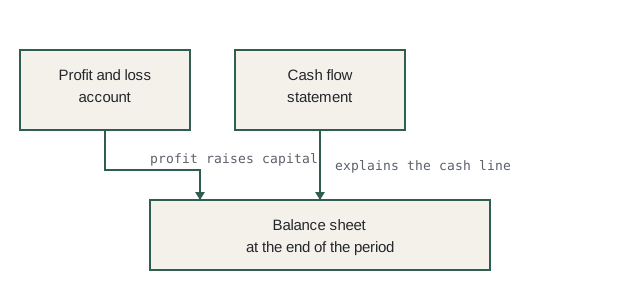
Retained profit for the period is added to the owner's stake on the balance sheet, and the closing cash on the cash flow statement is the same figure as the cash line on the balance sheet. If those connections do not hold, the accounts are not merely presenting badly; something is missing.
The gap between profit and cash is usually explained by four things: customers who have not paid yet, suppliers who have not been paid yet, stock sitting on shelves, and depreciation, which reduces profit without moving money. Knowing that list turns a confusing pair of numbers into a short set of specific questions.