Manual home / Keeping records / Chapter 6
Double entry in practice
Chapter 6 of 9 · explanatory only · no rates, thresholds or deadlines
The accounting equation, debits and credits, a worked example and a trial balance.
Double entry is often taught as a set of rules to memorise, which makes it seem harder than it is. It rests on one idea: everything a business holds was funded by somebody, and the two facts are recorded together every time.
6.1The accounting equation
What a business controls equals what it owes to outsiders plus what it owes to its owner. That is the whole framework:
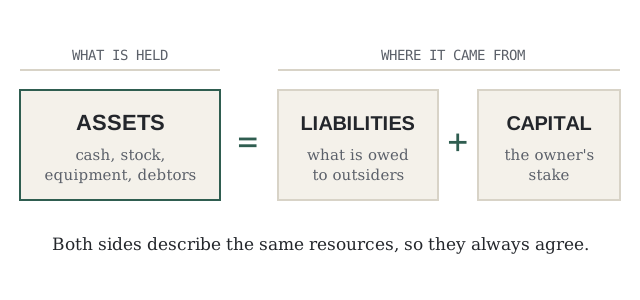
Because the two sides describe the same resources from different angles, they cannot get out of step. Any event that changes one side changes the other by the same amount, or changes two items on the same side in opposite directions. Recording both effects every time is what double entry means.
6.2Debits and credits
Debit and credit are just labels for the left and right of an account. They do not mean good and bad, and they do not mean increase and decrease; what they mean depends on the type of account:
| Account type | A debit | A credit |
|---|---|---|
| Assets | Increases | Decreases |
| Expenses | Increases | Decreases |
| Liabilities | Decreases | Increases |
| Capital | Decreases | Increases |
| Income | Decreases | Increases |
A working shortcut: assets and expenses behave one way, and everything else behaves the opposite way. Every entry has at least one debit and at least one credit, and the debits equal the credits.
6.3A worked example
The figures below are round illustrative numbers chosen to keep the arithmetic simple. They describe an imaginary one-person workshop in its first month and are not observed data.
| # | Event | Debit | Credit | Amount |
|---|---|---|---|---|
| 1 | Owner puts money into the business | Cash at bank | Owner's capital | 10,000 |
| 2 | Buys equipment, paying immediately | Equipment | Cash at bank | 4,000 |
| 3 | Buys materials on credit | Stock of materials | Trade payables | 1,500 |
| 4 | Sells for cash | Cash at bank | Sales | 2,500 |
| 5 | Sells on credit | Trade receivables | Sales | 1,200 |
| 6 | Materials used in those sales | Materials used | Stock of materials | 900 |
| 7 | Pays part of the supplier bill | Trade payables | Cash at bank | 900 |
| 8 | Pays rent for the month | Rent | Cash at bank | 300 |
| 9 | Charges one month of equipment wear | Depreciation charge | Accumulated depreciation | 100 |
| 10 | Customer from entry 5 has not yet paid | No entry: nothing has happened | — | |
Entry 10 is included on purpose. A very common beginner's error is to record the same sale twice, once when it is made and again when it is paid. The sale was recognised at entry 5; when the money arrives, the only entry is a movement from receivables to cash, which changes nothing about profit.
6.4The trial balance
Listing every account balance with debits in one column and credits in the other produces the trial balance. It is the first checkpoint of the whole system.
| Account | Debit | Credit |
|---|---|---|
| Cash at bank | 7,300 | — |
| Trade receivables | 1,200 | — |
| Stock of materials | 600 | — |
| Equipment | 4,000 | — |
| Accumulated depreciation | — | 100 |
| Trade payables | — | 600 |
| Owner's capital | — | 10,000 |
| Sales | — | 3,700 |
| Materials used | 900 | — |
| Rent | 300 | — |
| Depreciation charge | 100 | — |
| Totals | 14,400 | 14,400 |
6.5From the trial balance to the statements
The income and expense balances are collected into the profit and loss account: sales of 3,700 less materials used of 900, rent of 300 and depreciation of 100, giving a profit of 2,400 for the month. The asset, liability and capital balances form the balance sheet, with that 2,400 added to the owner's capital, because profit belongs to the owner. Chapter 8 reads both statements properly.