Manual home / Keeping records / Chapter 5
Bookkeeping basics
Chapter 5 of 9 · explanatory only · no rates, thresholds or deadlines
The record trail from source document to day book to ledger, and what it is actually for.
Bookkeeping has a reputation as an administrative chore performed for somebody else's benefit. It is better understood as the process of turning a pile of paper into a set of statements that answer questions: how much did we make, what do we own, what do we owe, and where did the cash go. Everything in this chapter exists to make those four questions answerable without guessing.
5.1What the books are for
Records serve at least four separate audiences, and a system built for only one of them tends to fail the others:
- The person running the business, who needs to know whether it is working, well before the year ends.
- Anyone lending or investing, who needs a basis for judgement other than assertion.
- The tax system, which needs a figure that can be checked against evidence.
- The future, including the person who has to explain a transaction long after everyone has forgotten it.
5.2The record trail
Every accounting system, from a paper cash book to a large ledger package, moves information along the same path. A transaction happens and produces a document. The document is entered into a book of first entry, in date order. Entries are grouped by account in the ledger. The ledger balances are listed in a trial balance. The trial balance becomes the statements.
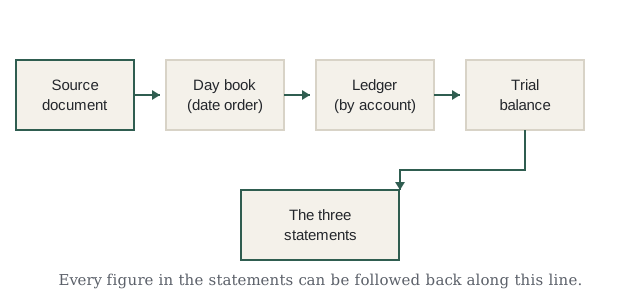
The direction of that arrow matters in both directions. Forwards, it summarises. Backwards, it is an audit trail: any number in the final accounts should be traceable to the documents behind it. A set of books where the trail is broken is not merely untidy; the totals cannot be checked at all.
5.3Source documents
The source document is the primary evidence, and its quality sets a ceiling on the quality of everything downstream. Sales invoices, purchase invoices, receipts, bank and card statements, delivery notes, contracts and payroll records are all source documents. Two habits do most of the work: file the document at the moment of the transaction rather than at the year end, and note on it anything that will not be obvious later, such as which project a cost belongs to.
5.4Single entry and double entry
Single-entry bookkeeping records one side of each event, usually the money: a list of receipts and a list of payments. It is fast, and for a very small operation with no stock, no credit and no assets it can be sufficient. Its limits appear immediately when any of those conditions fail. A list of payments cannot tell you what you are owed, what you owe, or what you hold.
Double entry records both sides of every event, on the principle that nothing arrives from nowhere. Every transaction has a source and a destination, and both are written down. That single discipline delivers two things single entry cannot: a complete picture of position as well as performance, and an internal check, because the two sides must agree in total.
5.5Accounts and the chart
An account is simply a place where entries of the same kind are collected: one for the bank, one for sales, one for rent, one for each category of cost. The list of accounts a business uses is its chart of accounts, and it is worth designing rather than accumulating. Too few accounts and the statements say nothing useful; too many and nobody maintains the distinctions, so the extra detail becomes unreliable.
Accounts fall into five types, and every entry belongs to one of them: assets, liabilities, capital, income and expenses. Chapter 6 shows how those five types interact.