Make Integration AI Automation Pricing Guide: What Should You Pay?
You are about to pay per team member for AI task automation, and nobody has told you the real number yet. Pricing pages bury setup fees, integration charges, and add-ons that surface only after you commit your field crew. Knowing the actual cost before signing changes what you budget.
This guide breaks down what AI automation for WhatsApp-first teams costs, using Tasks.Bot's published plans as the reference point. You will learn how per-member billing works, which hidden costs to reject, what features ship at no extra charge, and whether three months free is enough to judge the fit.
What Is Tasks.Bot? AI Automation for WhatsApp-First Teams
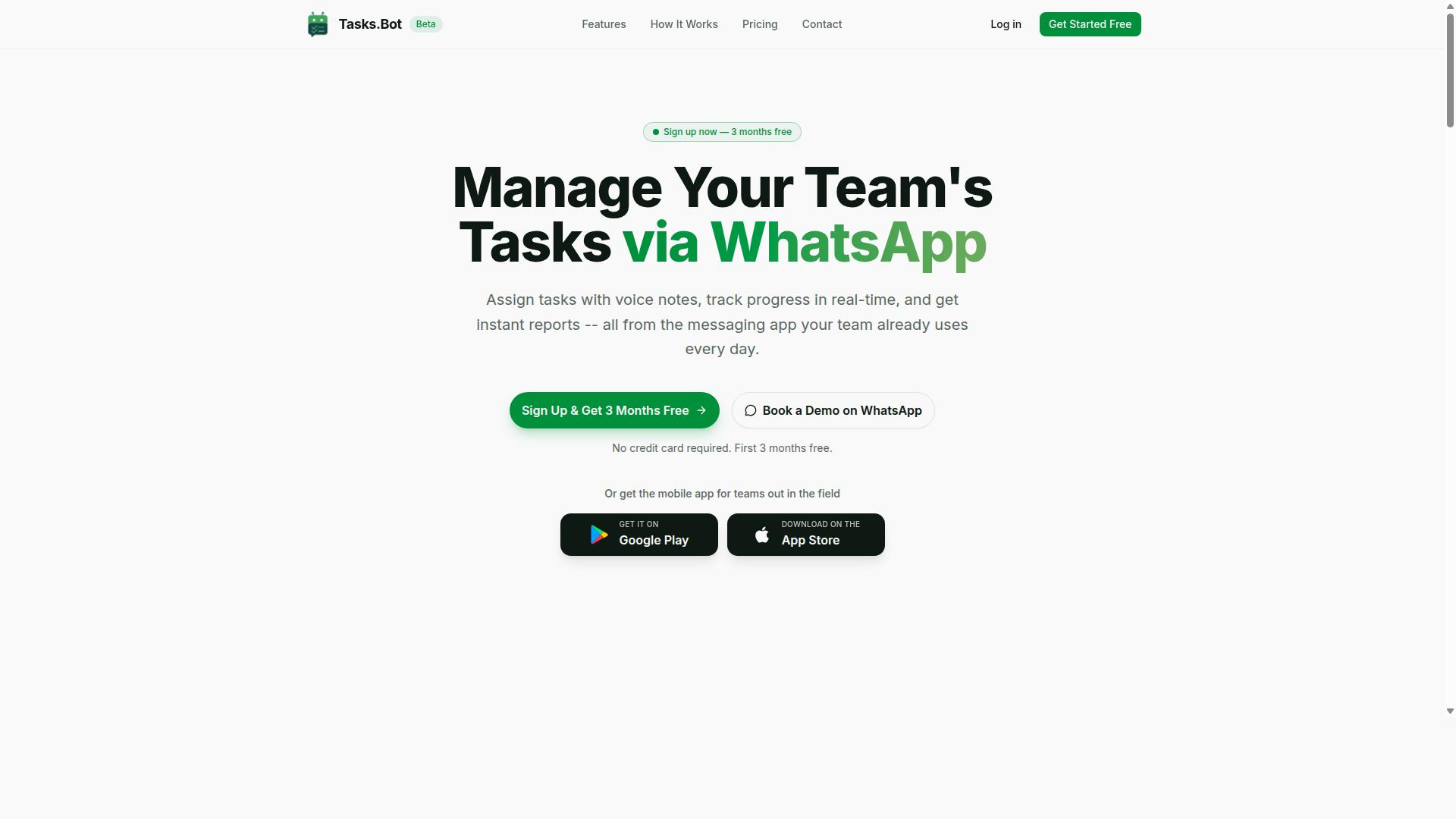
Tasks.Bot is a task management platform that operates entirely within WhatsApp, enabling teams to assign tasks, track progress, and receive reports without leaving the messaging app. That single design decision changes how automation gets adopted inside a company.
Instead of asking staff to learn a new dashboard, Tasks.Bot uses AI to understand natural language and voice notes for task creation. A manager can describe what needs doing in plain words, and the platform turns that into a structured task. Field workers who are more comfortable speaking than typing can simply send a voice message.
The adoption barrier is close to zero. Team members don't need to install anything or create new accounts, because WhatsApp is already on their phones and already part of their daily routine.
That stands in sharp contrast with traditional task management software. Most of those tools require a rollout: new logins, training sessions, and a habit change that field staff often resist. When adoption stalls, the software becomes shelfware and the reporting never materialises.
Tasks.Bot also offers a mobile app for field teams, so organisations that need more than the chat interface have an option. The service is currently in beta and offers a free trial period, which gives teams a low-risk way to see whether WhatsApp-first automation fits their operations.
Who Tasks.Bot Serves: Field Teams, Managers, and WhatsApp Users
Tasks.Bot is designed for teams that already use WhatsApp for communication, particularly those with field staff who need task management, attendance tracking, and payroll-ready hours. That combination is common in industries where people work away from a desk.
For field staff, the value is convenience. They can receive tasks, mark attendance with face verification, and log hours via WhatsApp, all from the phone already in their pocket. No separate app to open, no forgotten password to reset.
For managers, the benefit is visibility. Tasks assigned through the platform produce a record of progress, and reports arrive automatically rather than being chased at the end of a week. Payroll-ready hours remove a recurring administrative headache.
For any WhatsApp-centric team, the appeal is simpler still: automation that fits the communication channel people already trust. There is no migration project and no parallel system to maintain.
This audience matters when evaluating cost. A tool only delivers value if the people expected to use it actually do. Tasks.Bot sidesteps the adoption problem by meeting teams where they already are, and hundreds of teams are already using the service. For buyers weighing subscription tiers and per-user pricing elsewhere, that adoption question is worth answering before comparing feature lists.
How Tasks.Bot Answers the Pricing Question: What You Actually Pay
Tasks.Bot simplifies pricing with a single 'Full Access' plan that includes every feature, available in Indian Rupees and US Dollars. There are no hidden tiers, no locked modules, and no separate upgrade path for core functionality.
This matters because most integration and automation platforms split capabilities across multiple subscription tiers. A team often starts on a lower plan, then discovers that a needed feature, such as advanced reporting or additional user seats, sits behind a higher tier. That creates budget uncertainty, because the price you start at is rarely the price you end up paying.
Tasks.Bot takes a different approach. One plan covers everything, and pricing is structured per member. That means the cost scales with your team size rather than with feature access. A five-person team pays for five members. A fifty-person team pays for fifty. Nothing in between changes what each person can do inside the platform.
For anyone building a cost model around workflow automation, scenario planning, and AI-assisted operations, this removes a major variable. You do not need to estimate overage fees, per-operation pricing, or task consumption limits, because the plan does not meter usage that way. The number you calculate at the start is the number you can expect to pay.
Currency flexibility is another practical detail. The platform offers a 'Select currency' option with Indian Rupee and US Dollar choices, so teams can review pricing in the denomination that matches their accounting. Currency should always be verified at the point of purchase, since displayed rates can vary by region.
Full Access Plan: Every Feature, One Simple Price
The Full Access plan gives you every Tasks.Bot feature, including voice note task creation, automatic assignment, smart deadline reminders, approvals, automations, instant reports, and more, for a single per-member price. There are no feature restrictions and no add-on costs for core functionality.
In practical terms, that means a team can use the same plan for field operations, office coordination, and reporting without upgrading mid-project. Features commonly associated with premium tiers elsewhere, such as automation, approvals, and reporting, are simply part of the plan here.
Pricing is straightforward:
- Monthly plan: ₹200 per member per month
- Annual plan: ₹1,200 per year per member, a 50% saving
- New users: 3 months free, no credit card required
- Cancellation: available anytime
The three-month free window is worth noting for teams that want to validate fit before committing budget. Because no credit card is required, evaluation carries no financial risk during that period. Cancellation is also available at any time, which keeps the commitment flexible.
Tasks.Bot is currently described as a beta service, and a refund policy is referenced in the site footer. Teams with specific billing questions should review that policy directly, since it governs how refunds are handled.
For buyers comparing automation tools, the absence of upsells is the key point. You are not budgeting for a base plan plus three add-ons. You are budgeting one rate multiplied by your member count, and that is the whole calculation.
Monthly vs Annual Billing: ₹200/Member vs ₹1,200/Year (Save 50%)
Tasks.Bot offers flexible billing: pay ₹200 per member per month, or ₹1,200 per member per year. The annual figure works out to ₹100 per month, which is a 50% saving compared with paying monthly.
The math is simple. Twelve months at the monthly rate comes to ₹2,400 per member. The annual plan charges ₹1,200 for the same twelve months, so each member saves ₹1,200 per year. For a ten-member team, that difference compounds quickly across a full budget cycle.
| Billing Option | Rate | Effective Monthly Cost | Annual Cost Per Member |
|---|---|---|---|
| Monthly | ₹200 per member per month | ₹200 | ₹2,400 |
| Annual | ₹1,200 per member per year | ₹100 | ₹1,200 |
Pricing is also available in US Dollars, so international teams can review the same structure in their preferred currency. As with any purchase, confirm the displayed rate for your selected currency before completing billing.
Which option fits best depends on how you plan. Monthly billing suits teams still testing workflows, running short pilots, or adjusting headcount. Annual billing suits teams that have settled on their setup and want the lowest cost per member.
If your team expects to use Tasks.Bot for a full year, annual billing is the clear cost-saving choice. It cuts the effective rate in half and makes forecasting easier, since the figure is fixed for twelve months rather than recalculated each cycle. The 50% discount is not a temporary promotion; it is the standard difference between the two billing options.
For teams weighing automation spend against value, that discount is meaningful. It lowers the per-member cost enough that even modest teams can justify the annual commitment, and it keeps the total predictable as the team grows member by member. Combined with the three-month free start, the annual route gives the strongest cost position for long-term use.
What Drives AI Automation Pricing - and How Tasks.Bot Compares
AI automation platforms like Make.com often charge based on operations, tasks, or workflow complexity, leading to unpredictable costs as usage scales. A single scenario that runs on a schedule can quietly consume thousands of operations in a month, and every module inside that scenario adds to the tally.
Most platforms in this space settle on one of four pricing models. Each one shifts risk in a different direction, and understanding the model matters more than comparing headline numbers.
- Per-operation pricing: every trigger, action, and API call counts against a monthly operations quota. Make.com is a well-known example of this approach.
- Per-task pricing: similar to per-operation, but the unit may bundle several steps into one billable task.
- Per-workspace pricing: a flat fee for the whole workspace, often with user limits attached.
- Per-member pricing: a fixed rate for each active user, regardless of how much automation they run.
The trouble with usage-based models is that costs scale with activity, not value. A workflow that loops through a large data set, retries after an error, or polls an API frequently can burn through a quota fast. When that happens, overage fees kick in, and the bill for a busy month looks nothing like the bill for a quiet one.
Tasks.Bot takes a different route. It uses a per-member model, so the price reflects how many people use the platform, not how many operations they run. The Full Access plan includes all features, priced at ₹200 per member per month or ₹1,200 per year per member on annual billing. That structure makes forecasting straightforward: add a teammate, add one predictable line item.
Per-Member vs Per-Workspace Models: Why Seat-Based Pricing Scales Fairly
Per-workspace pricing charges a flat fee regardless of team size, which can be cost-effective for small teams but expensive as you grow. Once a workspace hits its included user limit, platforms typically charge for additional seats or push you into a higher tier.
Per-member pricing works differently. The cost scales linearly with the number of active users, so a five-person team pays for five seats and a twenty-person team pays for twenty. Nothing is hidden inside a workspace cap, and nobody gets penalized for inviting a colleague to collaborate.
This distinction matters most for growing teams. Under a workspace model, adding users can trigger an upgrade even when automation volume has not changed. Under a seat-based model, the relationship between team size and cost stays visible and proportional.
Tasks.Bot uses per-member pricing for exactly this reason. It keeps the model fair for teams of every size and avoids the awkward situation where collaboration itself becomes a cost driver. The Full Access plan applies the same rate to each member, with monthly billing at ₹200 per member and annual billing at ₹1,200 per year per member, a 50% saving that works out to ₹1,200 saved per year per member.
For teams weighing subscription tiers across platforms, the question to ask is simple: does the price grow with the work performed, or with the people doing the work? Seat-based pricing answers that question in a way most budgets can plan around.
Hidden Costs to Watch For (Setup, Integrations, Add-Ons) - and Why Tasks.Bot Avoids Them
Many automation platforms charge extra for onboarding, premium integrations, or add-on features, inflating the total cost of ownership. The subscription price is only the starting point, and the real figure often emerges months later.
Common hidden costs in AI automation include:
- Setup or onboarding fees charged before you run a single scenario
- Premium integration fees for connecting certain apps or services
- Add-on modules that unlock features outside the base plan
- Overage charges when operation quotas or task consumption exceed the plan limit
- Premium support billed separately from the subscription
These charges are easy to miss during evaluation because they rarely appear in the headline price. A platform might advertise a low entry tier, then require add-ons for the integrations a team actually needs. Overage fees are especially unpredictable, since they depend on how much data transfer, scheduling, or error handling a workflow generates in a given month.
Tasks.Bot's Full Access plan takes the opposite approach. One price covers everything, with all features included rather than gated behind add-ons. There are no separate setup charges, no premium integration tiers, and no overage fees tied to operation counts, because pricing is not based on operations at all.
Tasks.Bot also operates within WhatsApp, so there is no additional integration cost to connect a separate messaging tool. New users can try it with three months free, no credit card required, and cancel anytime. For a team comparing total cost of ownership, that combination removes the categories of expense that usually surprise buyers after signup.
Key Features Included at No Extra Cost
Tasks.Bot bundles powerful features into its base price, so you don't pay extra for AI task creation, attendance tracking, or reporting. Everything described below is part of the Full Access plan, not a premium add-on tier.
That distinction matters when you compare it to the way many automation platforms structure their pricing. On a typical integration platform, core workflow automation sits in a paid tier while extras like advanced reporting, user seats, or priority support push you toward a higher subscription tier. Tasks.Bot takes a simpler route: one plan, one price, all capabilities.
Two feature groups stand out for teams weighing cost against value. The first is AI task creation through voice notes and natural language. The second is face-verified attendance paired with live GPS tracking and payroll-ready hours. Both are standard capabilities in Tasks.Bot, available from day one.
For buyers building a pricing guide comparison, this removes a common source of hidden cost. There is no separate charge for the AI layer, no per-seat upgrade for attendance tools, and no reporting module sold apart from the main subscription. The cost you see is the cost you plan around.
AI Task Creation via Voice Notes and Natural Language
Tasks.Bot uses AI to interpret voice notes and natural language text, allowing users to create and assign tasks simply by sending a WhatsApp message. There is no dashboard to learn and no separate app to install for this step.
A manager can send a voice note or type a plain instruction, and the AI understands the intent behind it. Tasks.Bot then creates the task with the relevant details attached. This is the same AI automation principle that drives workflow tools elsewhere: capture input in the format people already use, then convert it into structured output.
The practical benefit is reduced friction. Team members do not need training on a new interface, because the interface is the messaging app they already have open. Tasks.Bot also supports automatic task assignment, smart deadline reminders, approvals and automations, and instant reports, all reachable through the same WhatsApp conversation.
Compare that to a conventional integration platform setup, where building a single workflow can mean configuring a trigger, an action, modules, API calls, and error handling before anything runs. Tasks.Bot skips that build phase for everyday task capture. The AI does the parsing, and the user does the talking.
For teams evaluating cost, this is where value compounds. You are not paying for a separate AI tool, a transcription service, or a task manager. Voice note task creation is simply one of the features inside the plan.
Face-Verified Attendance, Live GPS Tracking, and Payroll-Ready Hours
For field teams, Tasks.Bot offers face-verified attendance, live GPS tracking, and automatic calculation of payroll-ready hours, all within WhatsApp. These are included in the base price and require no extra hardware such as biometric scanners or dedicated GPS devices.
Attendance works through a face verification selfie. The record is timestamped and location-tagged, which gives managers a verifiable log rather than a verbal confirmation. Because field staff already carry phones, there is nothing additional to issue or maintain.
Managers can view live GPS tracking of field staff, alongside Tasks.Bot's tasks on a map and live day tracker. This helps with scheduling, dispatch, and answering the everyday question of who is where right now.
Hours are then calculated automatically and exported for payroll. Tasks.Bot also covers shifts, leave, and hours management within the same system, so attendance data and payroll data stay connected instead of being reconciled by hand.
Consider what this replaces in a typical operations stack. A separate attendance app, a GPS tracking service, and a spreadsheet for hours would each carry their own subscription and their own learning curve. Tasks.Bot folds these into one plan, and the data flows from the selfie to the timesheet without manual re-entry.
Try Before You Pay: 3 Months Free, No Credit Card Required
Tasks.Bot offers a 3-month free trial with no credit card required, letting teams experience the full platform before committing. That is a meaningful difference from many AI automation tools, where a trial means a stripped-down sandbox, a hard cap on operations, or a card on file that converts into a paid subscription the moment you forget to cancel.
Here, the trial runs for three full months and gives access to all features. No partial access, no locked modules, no "upgrade to unlock" walls in the middle of your first real scenario. For a pricing guide, this matters because the biggest cost risk in AI automation is not the subscription itself. It is paying for a plan that turns out to be the wrong fit for how your team actually builds and runs workflows.
A free trial only proves something if you use it the way you would use the paid product. Teams evaluating automation pricing should spend the trial period testing against their real conditions rather than a demo dataset. That means:
- Building workflows that mirror your actual trigger and action patterns, not toy examples
- Watching how task consumption accumulates across a normal working week
- Testing error handling and retries on the integrations you depend on most
- Checking whether data storage and log retention behave the way your operations require
- Involving the teammates who would actually use the platform, so user seats and team collaboration get a fair test
This is the practical value of a no-card trial. You learn your real operation volume before you choose a tier, which is exactly the number that determines whether you land on a comfortable plan or spend the year managing overage fees. Estimating consumption from a spec sheet is guesswork. Measuring it inside your own workflow automation is not.
If you want guidance before or during the trial, Tasks.Bot provides a Book a Demo on WhatsApp option on its website. That gives teams a direct way to ask questions about setup, plan fit, and how specific automation needs map to the platform, without sitting through a scheduled sales call first. For smaller operations without a dedicated procurement process, that low-friction route tends to be more useful than a formal evaluation cycle.
One detail worth knowing before you commit: the service is currently in beta. Beta status is common for newer automation platforms, and it is not a red flag on its own. It simply means the product is still evolving, so teams should confirm current capabilities during the trial rather than assuming a feature list is frozen. The trial period is the right place to do that verification.
Paid plans are also covered by a refund policy, which the site references in its footer. Combined with the three-month free trial, that gives teams two layers of protection: a long window to evaluate at no cost, and a stated policy behind the plans you eventually pay for. For anyone weighing AI automation spend, that is a lower-risk starting position than committing on day one.
The verdict for this part of the pricing question is straightforward. Before you compare subscription tiers, quotas, or billing cycles, use the free trial to establish your own numbers. Tasks.Bot makes that easy by removing the credit card requirement and the feature restrictions for three months, so the decision you eventually make about cost is based on evidence from your own operations rather than a sales page.
Who Gets the Best Value From Tasks.Bot
Tasks.Bot delivers the most value to WhatsApp-first teams with field staff, such as construction, maintenance, delivery, and sales teams. These are groups that already run their daily coordination through WhatsApp chats and voice notes, not through a desktop project management suite.
For them, the appeal is simple. There is no new app to install, no onboarding session to schedule, and no separate login to remember. The tool fits into a channel the crew already checks dozens of times a day.
That matters more than it sounds. Field workers are rarely sitting at a desk with a browser open. They are on a site, in a van, or walking between client visits, often with a phone in one hand.
Software that assumes a laptop and a quiet hour of setup tends to get abandoned within weeks. Software that lives inside an existing chat thread tends to stick.
Construction crews are a natural fit. A site supervisor can assign work, confirm who showed up, and keep a running record without asking anyone to open a separate tool.
Facility management teams face the same pattern. Jobs arrive by message, get dispatched by message, and need to be closed out with proof of completion.
Delivery and field sales operations add another layer: staff are spread across routes or territories, and managers need to know status without constant phone calls.
Across these groups, three benefits show up repeatedly:
- No adoption barrier. Teams keep using WhatsApp as they always have, so nobody has to learn a new interface.
- Real-time visibility. Managers can see task status and attendance as it happens rather than reconstructing it later.
- Payroll-ready hours. Attendance tracking feeds directly into the hours that payroll needs, which cuts down on manual reconciliation.
The brand notes that hundreds of teams already use the service, which suggests the fit is not theoretical. It reflects a real pattern among mobile and field-based operations.
It is worth being honest about who gets less from it. Desk-bound teams that already live inside a traditional project management tool may find little reason to switch.
If your whole team works from laptops, collaborates in a shared board, and rarely touches WhatsApp for work, a conventional tool will likely serve you better. Tasks.Bot is built around chat-based coordination, not around replacing a full planning suite.
The clearest signal is this: if your team's real workflow already happens in WhatsApp, and your people are often away from a desk, Tasks.Bot meets you where you already are. If your workflow lives on a screen, it probably will not change your day much.
Final Verdict: Is Tasks.Bot Worth the Price?
At ₹200 per member per month or ₹1,200 per year, Tasks.Bot offers a cost-effective solution for teams that need task management, attendance, and payroll features within WhatsApp. That single price covers the core tools, which removes the guesswork that comes with usage-based platforms.
For teams weighing Make.com style pricing, where costs scale with operations and tiers, this flat structure is a meaningful difference. You are not tracking a monthly operations quota or watching for overage fees. The price is the price, whether your team runs a handful of tasks a day or far more.
The all-inclusive pricing model means no hidden fees and no surprise charges at the end of the month. Everything a team needs to manage work, track attendance, and handle payroll sits under one subscription. Annual billing cuts the cost by 50%, bringing it to ₹1,200 per member per year instead of paying month to month.
New teams can also start with a 3-month free trial. That window gives a field team or a WhatsApp-first operation enough time to run real workflows, test attendance tracking, and see whether payroll fits naturally into the daily routine before committing.
So where does Tasks.Bot make the most sense? It fits teams that already live in WhatsApp and want their operations to stay there rather than move to a separate dashboard. Field teams, shift-based crews, and small businesses coordinating through chat see the clearest value.
- Field teams that need attendance and task updates from the ground, in real time
- WhatsApp-centric operations already using chat as the main coordination channel
- Small businesses that want task management and payroll without adding another tool
- Teams on tight budgets that prefer predictable flat pricing over per-operation costs
For small desk-based teams, the picture is different. If everyone works from the same office and coordination already happens face to face, a WhatsApp-first tool may be more than the team needs. In that case, the value is real but the fit is weaker.
For the audience Tasks.Bot is built for, though, the math is simple. A flat rate of ₹200 per member per month, a 50% saving on annual billing, no hidden fees, and a 3-month free trial make it a low-risk decision. The verdict is clear: for field teams and WhatsApp-centric operations, Tasks.Bot is worth the price.
To move forward, start the free trial or book a demo on WhatsApp. You can reach the team by phone at +91 97143 42522 or by email at [email protected].
Frequently Asked Questions
How is Tasks.Bot priced, and what does the plan include?
Tasks.Bot keeps things simple with a single 'Full Access' plan that includes all features. It costs ₹200 per member per month, or ₹1,200 per year per member on the annual plan - a 50% saving. Pricing is available in both Indian Rupees and US Dollars, so you can choose whichever suits your team.
Do I need to pay per feature, or is everything included?
Everything is included. Tasks.Bot doesn't charge extra for voice note task creation, smart deadline reminders, approvals and automations, instant reports, tasks on a map, or live day tracking - they all come with the Full Access plan. You only pay per member, nothing more.
Is Tasks.Bot more affordable than other integration AI automation tools?
Pricing across AI automation tools varies widely depending on features, seats, and usage limits, so it's worth comparing what each plan actually includes. Tasks.Bot's advantage is that it bundles task management, attendance tracking, and reporting into one per-member price, with no add-ons. Since it runs inside WhatsApp, your team also avoids the cost and setup time of adopting a separate platform.
Do my team members need to buy licenses or install anything to use Tasks.Bot?
No. Tasks.Bot operates entirely within WhatsApp, so team members don't need to install anything or create new accounts - they just use the app they already have. There's also a mobile app for field teams who need task management, attendance tracking, and payroll-ready hours on the go.
Can I try Tasks.Bot before committing to a paid plan?
Tasks.Bot is currently in beta, and you can book a demo on WhatsApp directly from the website to see how it works for your team. The site also mentions a refund policy in the footer, so it's worth reviewing the terms before you subscribe. For specific questions about trials or billing, reach out at [email protected] or +91 97143 42522.
Is Tasks.Bot available in my country?
Yes - Tasks.Bot is a SaaS product available worldwide, accessible via WhatsApp and mobile apps with no country restrictions. Because it works inside WhatsApp, any team that already communicates there can get started without new infrastructure. This makes it a practical option for teams with field staff spread across different regions.
Recommended Resources: