Karo.bot vs Tasks.Bot for AI Agent Creation Software
Choosing AI agent software usually starts with a spreadsheet of features nobody uses. Your team needs task assignment, attendance tracking, and reports inside WhatsApp, not another dashboard to check. Karo.bot and Tasks.Bot both claim that ground, so the decision comes down to fit.
This article explains how Tasks.Bot handles AI task creation through natural language and voice notes, what its field tools cover, and where a beta product stands on encryption and refunds. By the end, you will know whether Tasks.Bot suits your team or whether another option fits better.
What Is Tasks.Bot? AI Agent Creation Software Explained
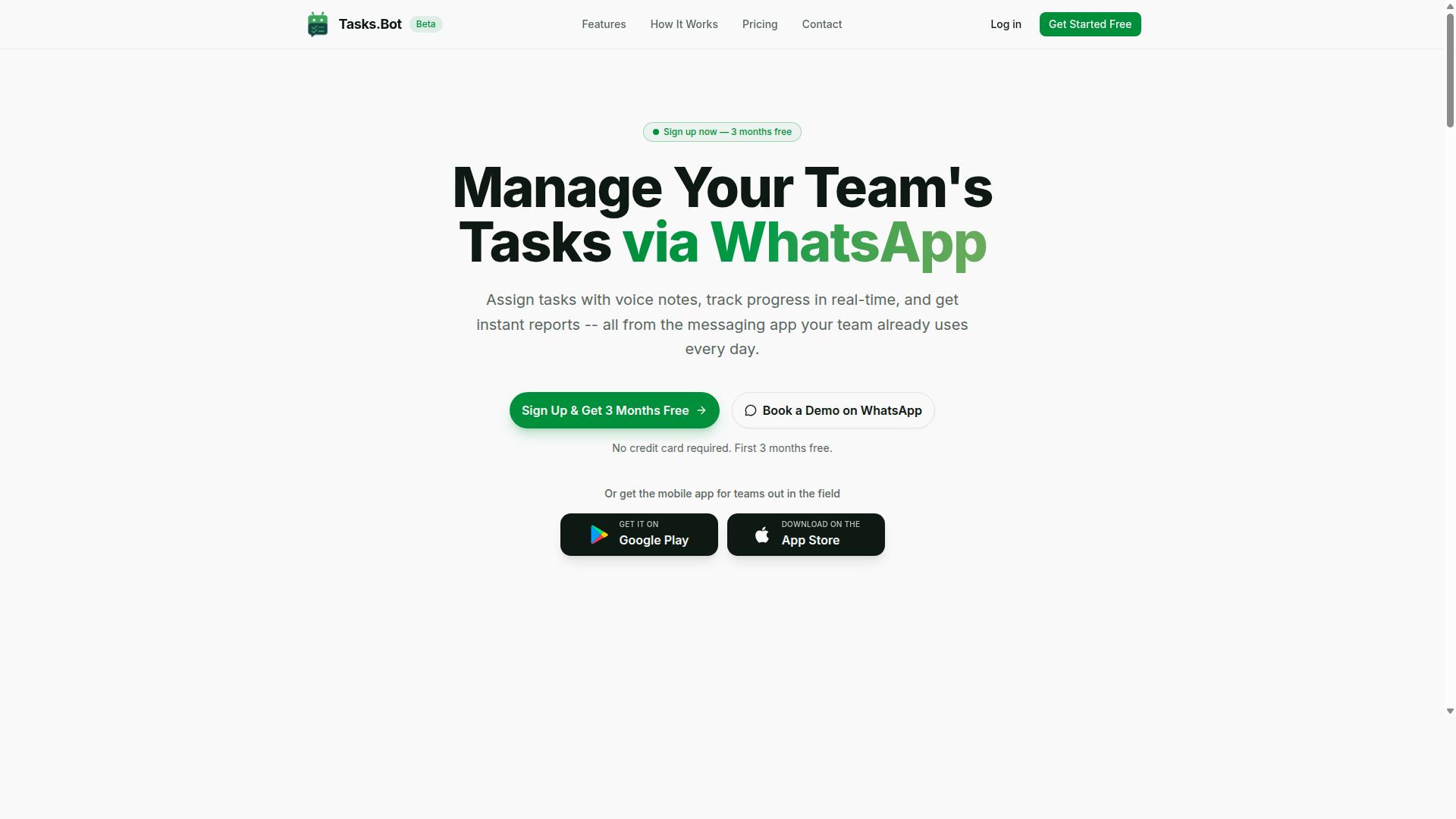
Tasks.Bot is a task management platform that operates entirely within WhatsApp, enabling teams to assign tasks, track progress, and receive reports without leaving the messaging app. It is a specialized AI agent creation tool built around one clear purpose: task orchestration for real teams doing real work.
That focus separates it from a general-purpose AI agent builder like Karo.bot. Karo.bot targets broad automation, where users design autonomous agents, wire up API connectivity, and map multi-agent systems through a visual development environment. Tasks.Bot takes a narrower path. It uses AI to automate task-related workflows, from assignment to reporting, rather than asking users to architect agent logic from scratch.
The most distinctive part of the approach is where it lives. There is no new app installation required to get started, because the core experience runs inside WhatsApp, a tool most teams already have open all day. Natural language processing handles the input side, so a message written the way a person actually talks can become a structured task.
Tasks.Bot is currently in beta and serves hundreds of teams globally. That status matters for anyone comparing it to a mature no-code AI platform. A beta product tends to move fast and improve quickly, and the teams already using it are shaping how the task orchestration layer develops. For readers weighing AI agent creation software, Tasks.Bot represents the lean, communication-first end of the spectrum, while Karo.bot represents the build-anything end.
Who Tasks.Bot Serves and How It Works on WhatsApp
Tasks.Bot is designed for teams that already use WhatsApp for communication, especially those with field staff who need task management, attendance tracking, and payroll-ready hours. If a crew is spread across sites, routes, or client locations, the messaging app is often the only channel everyone checks consistently.
That audience shapes every design decision. Instead of asking a citizen developer to learn prompt engineering or drag-and-drop interface conventions, Tasks.Bot meets people in the conversation they were already having. No new accounts are needed beyond that familiar setup, which lowers the barrier for workers who are not sitting at a desk.
Day to day, the flow looks like this:
- Create tasks by sending a message in natural language or a voice note.
- Assign tasks automatically based on what was communicated.
- Set smart deadlines so work carries a clear due date.
- Receive instant reports on progress without chasing anyone down.
A mobile app supports field teams who need more than chat alone, covering attendance tracking and payroll-ready hours alongside the task list. This is where the difference from a typical workflow automation tool shows up. Tasks.Bot is not trying to be a Zapier alternative or a Make.com competitor with dozens of triggers and actions. It is a focused agent builder for the work that happens between a manager and a mobile team.
The service is in beta and offers a free trial period, so teams can see how the WhatsApp-native model fits before committing. For organizations already coordinating by message, that combination of natural language processing, automatic assignment, and instant reporting turns a chat thread into a lightweight task orchestration system. Hundreds of teams are already using it, and the pattern is consistent: less setup, faster adoption, and reporting that arrives on its own.
Karo.bot vs Tasks.Bot: Which Is Better for AI Agent Creation?
Karo.bot and Tasks.Bot both offer AI-powered automation, but they cater to different needs: Karo.bot focuses on building autonomous AI agents for complex workflows, while Tasks.Bot specializes in task management within WhatsApp. Understanding that split is the key to choosing correctly, because the two products solve different problems even though both sit under the broad umbrella of AI agent creation software.
Karo.bot is best understood as a general-purpose agent builder. Platforms in this category typically lean on large language models, prompt engineering, and custom agent logic to construct autonomous agents that reason through multi-step jobs. Builders in this space often expose a visual development layer, with drag-and-drop interface elements, conditional branching, triggers, actions, and scheduling, so users can shape event-driven automation without writing code from scratch.
That approach suits teams exploring multi-agent systems, API connectivity, and webhook support. It also attracts the technically curious: people comfortable with prompt design, low-code development, and connecting third-party integrations. When someone searches for a Zapier alternative, a Make.com competitor, or an n8n comparison, they are usually hunting for that kind of orchestration engine.
Tasks.Bot takes a different route. It is not a canvas for assembling abstract agents. It is a task orchestration tool that lives entirely inside WhatsApp, so team members do not need to install anything or create new accounts. There is no separate app to learn and no onboarding hurdle for staff who already use WhatsApp every day.
The interface difference matters more than it first appears. A visual builder rewards users who enjoy mapping logic on screen. A WhatsApp-based tool rewards users who simply want work assigned, tracked, and confirmed. For a field crew or a small operations team, the second option removes an entire layer of friction.
Target users diverge along the same line. Karo.bot-style platforms tend to appeal to citizen developers, automation enthusiasts, and technical teams building reusable agent templates or pre-built agents. Tasks.Bot is built for teams with field staff and frontline workers, where adoption speed and simplicity outweigh customization depth.
Where Tasks.Bot stands apart is in what it does with AI once a message arrives. It uses natural language processing to understand natural language and voice notes for task creation. A supervisor can describe a job the way they would speak it aloud, and the system handles the rest, which lowers the skill barrier considerably compared with prompt engineering.
Tasks.Bot also adds capabilities that general agent builders rarely touch. It offers face-verified attendance and live GPS tracking for field staff, features aimed at verifying that work actually happened at the right place and time. Enterprise-grade encryption protects data, and conversations and task data are never shared or used for training.
Cost of entry is another practical divider. Tasks.Bot provides a 3-month free trial with no credit card required, which lets a team validate fit before committing. That structure favors buyers who want to test real usage with real staff rather than evaluate a builder in the abstract.
So which is better? Neither wins universally, and the honest answer depends on the job at hand. The table below summarizes the practical split.
| Dimension | Karo.bot | Tasks.Bot |
|---|---|---|
| Primary purpose | General AI agent creation and workflow automation | Task management and task orchestration |
| Interface | Visual builder style | Operates entirely within WhatsApp |
| Setup for staff | Typically requires account creation | No installs or new accounts needed |
| Input method | Prompt and logic design | Natural language and voice notes |
| Best-fit users | Citizen developers, technical teams | Teams with field staff |
| Field verification | Not a focus | Face-verified attendance and live GPS tracking |
Choose Karo.bot when the goal is constructing autonomous agents, experimenting with custom agent logic, or wiring together multi-agent systems and third-party integrations. It fits exploratory automation work where flexibility and depth matter more than speed of rollout.
Choose Tasks.Bot when the goal is getting real work done by real people, quickly, without training sessions or app fatigue. It suits teams that assign jobs in the field, need attendance and location verification, and want AI that understands plain speech instead of structured input.
For most organizations weighing AI agent creation software against everyday operational needs, the deciding question is simple. Are you building agents, or are you managing tasks? Karo.bot answers the first. Tasks.Bot answers the second, and it does so inside the app your team already has open.
Key Features and What Makes Tasks.Bot Stand Out
Tasks.Bot offers a suite of features designed to streamline task management for teams that rely on WhatsApp, from voice note task creation to automatic reminders and instant reports. Instead of asking teams to adopt yet another dashboard, it works inside the messaging app they already use every day. That design choice shapes everything about how the product functions.
The core feature set covers the full task lifecycle:
- Voice note task creation for quick capture without typing
- Automatic task assignment so work reaches the right person
- Smart deadline reminders that keep timelines visible
- Approvals and automations for repeatable processes
- Instant reports for a clear view of progress
- Tasks on a map and a live day tracker
- Shifts, leave, and hours management
Because Tasks.Bot operates entirely within WhatsApp, team members do not need to install anything or create new accounts. There is no separate login to remember and no second app competing for attention. The platform also provides Android and iOS apps with push notifications, voice capture, and a home screen widget for people who want a native mobile experience alongside WhatsApp.
Security matters when conversations and task data live in a chat thread. Tasks.Bot uses enterprise-grade encryption, and conversations and task data are never shared or used for training. The service is currently in beta and continuously improving, with a 3-month free trial that requires no credit card. For teams weighing AI agent creation software, these features show where Tasks.Bot concentrates its effort: practical, chat-native task orchestration rather than abstract agent building.
AI Task Creation via Natural Language and Voice Notes
Tasks.Bot leverages AI to interpret natural language and voice notes, allowing users to create tasks simply by sending a WhatsApp message or voice clip. The AI understands user intent and creates tasks from messages, so the barrier between thinking of work and recording it nearly disappears.
Natural language processing means no complex forms and no field-by-field data entry. A user can type something like "Send invoice to client by Friday," and the system extracts the key details: the task name, the assignee, and the deadline. The same applies to spoken input. A voice note saying "Remind John to call the supplier tomorrow" carries enough context for the AI to turn it into a structured task.
This approach saves time in several practical ways:
- No switching to a separate tool to log a task
- No filling out structured forms with multiple fields
- No reformatting a thought into rigid syntax
For teams comparing an agent builder with a visual development or drag-and-drop interface against a chat-first tool, the trade-off is clear. Tasks.Bot does not ask users to design conditional branching or map out triggers and actions. It reads intent from ordinary language instead. That makes it accessible to a citizen developer or any team member, without prompt engineering skills or training in custom agent logic.
Voice capture also suits hands-busy environments, from warehouses to job sites. The Android and iOS apps support voice capture directly, and the home screen widget keeps capture one tap away. The result is fewer forgotten tasks and a lower chance that a verbal instruction disappears into a chat scroll.
Field Team Tools: Face-Verified Attendance and Live GPS Tracking
For teams with field staff, Tasks.Bot includes face-verified attendance and live GPS tracking to ensure accountability and real-time visibility. These two features sit alongside the task management layer rather than replacing it, which is what makes them useful in daily operations.
Face-verified attendance confirms that the right person is checking in, not a colleague with a shared phone. For businesses that pay field staff by the hour, that distinction protects payroll accuracy and reduces disputes. Live GPS tracking gives managers location monitoring in real time, so they know where field work is happening without constant phone calls.
These tools connect to task orchestration in a practical way. Tasks can be assigned based on location, which means the nearest available person receives the job. The platform also handles shifts, leave, and hours management, tying attendance records to the same system that tracks work completion. Tasks on a map and a live day tracker round out the picture.
This combination is one of the clearest unique selling points in the product. Many task tools assume everyone sits at a desk. Tasks.Bot treats field staff as first-class users, with verification and visibility built into the same WhatsApp workflow their teams already follow. Since the service operates within WhatsApp, field workers do not need to install anything or create new accounts, and enterprise-grade encryption protects the data they generate.
The platform is in beta and continuously improving, so these capabilities should be evaluated as part of an evolving product. Even so, the direction is consistent: practical, chat-native tools for teams that split their time between the office and the field.
Pricing and Plans
Tasks.Bot offers a single 'Full Access' plan with all features included, priced in Indian Rupees and US Dollars. There are no confusing tiers to compare, no feature gates, and no upsells hidden behind a higher bracket. Every user gets the complete platform from day one.
This single-plan approach removes a common frustration in AI agent creation software. Many buyers spend hours comparing tiers only to discover that autonomous agents or advanced workflow automation sit behind the most expensive option. Tasks.Bot keeps the decision simple.
Pricing is listed in two currencies. The site shows a 'Select currency' option with Indian Rupee and US Dollar choices, so users should confirm their preferred currency before subscribing.
| Plan | Price | Billing Cycle |
|---|---|---|
| Monthly | ₹200 per member | Per month |
| Annual | ₹1,200 per member | Per year |
The annual plan works out to a clear discount. Paying monthly costs ₹2,400 over a year, while the annual option costs ₹1,200. That is a 50% saving, or ₹1,200 saved per member each year.
For teams, the per-member structure matters. A small group of five on the annual plan pays ₹6,000 per year in total, which keeps task orchestration affordable for startups and small departments alike.
New users also get 3 months free, with no credit card required, and can cancel anytime. That gives anyone evaluating Tasks.Bot as a no-code AI platform a genuine window to test the agent builder before paying.
Tasks.Bot is currently in beta, and a refund policy is in place. Buyers should read the current refund terms on the site before purchase, since beta-stage products can update their policies as the platform evolves.
When comparing costs across AI agent creation software, look beyond the headline number. Factor in per-member charges, annual discounts, free trial length, and refund terms together. On those measures, Tasks.Bot keeps entry costs low while including every feature in one plan.
Trust Signals: Beta Status, Encryption, and Refund Policy
Tasks.Bot is currently in beta, which means it's still evolving, but it already implements encryption and offers a refund policy to build trust. For anyone weighing a no-code AI platform for real work, that combination matters more than a polished launch badge.
Beta status is a transparency signal, not a red flag. It tells you the product is under active development, features may shift, and occasional bugs are possible. In exchange, early users get access to an agent builder that is being shaped and improved continuously rather than frozen between major releases.
Encryption is listed as a core part of the platform's data handling. Specific technical details are not published, so the practical takeaway is simple: data security is treated as a priority for anyone building autonomous agents that touch business workflows.
The site also states a refund policy in the footer, which gives buyers a documented path if the tool does not fit their needs. Always read the exact terms before purchasing, since policies can be updated as the beta progresses.
If you prefer to evaluate before committing, Tasks.Bot offers a Book a Demo on WhatsApp option. A live walkthrough lets you ask about agent templates, triggers, conditional branching, and API connectivity before you spend anything.
Weigh these signals together and the picture is consistent: an early-stage AI agent creation tool that is open about where it stands, protective of user data, and willing to stand behind its refund terms. The copyright year on the site reads 2026, a small detail that confirms the platform is actively maintained rather than abandoned.
For a citizen developer or team comparing a Zapier alternative or Make.com competitor, that honesty is worth more than a long feature list. A roadmap you can see beats a promise you cannot verify.
Who Should Use Tasks.Bot
Tasks.Bot is ideal for teams that already communicate via WhatsApp and need a lightweight, AI-powered task management solution, especially those with field staff. Instead of forcing everyone onto a new platform, it meets people where they already are.
The platform serves teams that use WhatsApp for communication, particularly those managing field staff who need task management, attendance tracking, and payroll-ready hours. Hundreds of teams already rely on the service, which suggests the approach resonates with groups that want practical tools rather than another app to learn.
What makes Tasks.Bot a strong fit is the absence of friction. There is no new app to download, no separate login to remember, and no training session required before work can begin. The team keeps using the same chat thread it already depends on every day.
Task creation stays simple because AI handles the heavy lifting. A manager can describe what needs to happen in plain language, and the system turns that into an organized task. This matters for supervisors who are coordinating people in the field and do not have time to build out detailed project structures.
Several team profiles tend to get the most value from this setup:
- Small to medium teams on WhatsApp that want structure without adopting a full project management suite
- Field service crews in delivery, maintenance, and sales who need assignments pushed to people on the move
- Operations leads who must track attendance and hours that feed directly into payroll
- Managers of distributed staff who need visibility into who is doing what, without chasing updates across multiple tools
These groups share a common trait. Their work happens away from a desk, and their communication already runs through chat. Adding a formal task system on top of that usually fails because adoption drops. Tasks.Bot avoids that problem by staying inside the channel people already open dozens of times a day.
It is worth being honest about where this approach fits less well. Teams running complex, multi-stage projects with heavy dependencies, Gantt-style timelines, or detailed resource planning may find they need a dedicated project management platform. Tasks.Bot is built for lightweight, AI-powered task management, not for orchestrating large programs with dozens of interconnected workstreams.
That distinction matters when choosing a tool. A construction firm tracking permits, subcontractors, and phased milestones across months has different needs than a maintenance team dispatching daily jobs. The first group likely needs deeper scheduling and dependency features. The second group benefits from speed and simplicity.
Tasks.Bot also suits teams that have tried heavier software and watched it go unused. When a tool requires everyone to change habits, compliance tends to fade within weeks. Meeting teams inside WhatsApp removes that barrier almost entirely, because the behavior is already established.
For organizations weighing whether to adopt a no-code AI platform at all, the practical question is simpler: does the team already live in chat, and does it have people working outside an office? If both answers are yes, Tasks.Bot is a natural match. It turns everyday messages into tracked work, keeps attendance and hours in one place, and does so without demanding a new workflow.
Final Verdict: Is Tasks.Bot the Right AI Agent Creation Choice?
Tasks.Bot is not a general AI agent creation platform like Karo.bot, but it excels as a specialized AI-powered task management tool for WhatsApp-centric teams. The comparison really comes down to what you are trying to build. If your goal is designing autonomous agents with custom logic, conditional branching, and multi-agent systems, Tasks.Bot is not positioned for that job.
If your goal is capturing work, assigning it, and tracking it without leaving WhatsApp, Tasks.Bot is built for exactly that. It brings AI task creation and field team tools into a messaging app your team already uses daily.
That distinction matters because the phrase "AI agent creation software" gets applied loosely. Some buyers mean a full agent builder with a visual development canvas and drag-and-drop interface. Others mean a practical tool that uses AI to turn conversations into organized tasks. Tasks.Bot serves the second group, and it does so with a clear focus.
Here is the honest summary of where each option fits:
- Choose Tasks.Bot if you need task management that lives inside WhatsApp, with AI assistance for creating tasks and tools designed for field teams.
- Consider Karo.bot if you are building autonomous agents and need an agent builder with custom agent logic, triggers, and workflow automation as the core purpose.
- Treat them as complementary if your organization runs field operations and also wants to experiment with agent-based automation elsewhere.
Tasks.Bot's strengths are easy to state plainly. WhatsApp integration removes the adoption barrier that kills most task management rollouts. AI task creation reduces the friction of writing out assignments by hand. Field team tools address the reality that many workers are mobile, not desk-bound. These are the reasons teams adopt it, and they are the reasons it holds up in daily use.
The limitations deserve equal honesty. Tasks.Bot is in beta status, which means the product is still evolving, and buyers should expect that. It is also not built for complex agent building. Anyone hoping to design multi-agent systems with sophisticated branching logic will find that Tasks.Bot is the wrong category of tool, not a weaker version of the right one.
So is Tasks.Bot the right AI agent creation choice? The answer depends entirely on the definition you are working from. As a general agent creation platform, no. As a specialized AI-powered task management tool that turns WhatsApp into an organized work channel, yes, and it is a strong one.
For teams weighing this decision, the practical test is simple. List the outcomes you need in the next quarter. If those outcomes are assigned work, visible progress, and field coordination inside WhatsApp, Tasks.Bot matches them directly. If they are autonomous agents, event-driven automation, and API connectivity across systems, look at a dedicated agent builder instead.
Many organizations will land on using both, and that is a reasonable outcome. Tasks.Bot handles the operational layer where real work gets captured and completed. A general agent platform handles the automation layer where processes run themselves. Neither replaces the other, and treating them as rivals misses the point.
If you want to evaluate Tasks.Bot against your own workflow, the team is reachable directly. You can call +91 97143 42522 or email [email protected]. There is also a Book a Demo on WhatsApp option, which is a fitting way to see a WhatsApp-first product in action.
The verdict: Tasks.Bot is a focused, credible tool for WhatsApp-centric task management and field team coordination. It is honest about what it is, and what it is happens to solve a problem most teams genuinely have.
Frequently Asked Questions
What's the main difference between Karo.bot and Tasks.Bot?
Tasks.Bot is a task management platform that runs entirely inside WhatsApp, so your team can assign tasks, get reminders, and receive reports without installing anything or creating new accounts. Karo.bot is another tool in the AI agent creation space, and the right fit depends on whether you want your workflows to live where your team already communicates. If your team already runs on WhatsApp, Tasks.Bot keeps everything in one place.
Do I need to install an app or create new accounts to use Tasks.Bot?
No. Tasks.Bot operates entirely within WhatsApp, so team members don't need to install anything or sign up for a new platform. There's also a mobile app available for field teams who need it. This makes onboarding fast, especially for staff who aren't comfortable with new software.
How does Tasks.Bot handle task creation with AI?
Tasks.Bot uses AI to understand natural language and voice notes, so you can create tasks just by typing or speaking a message in WhatsApp. It also supports automatic task assignment, smart deadline reminders, approvals, and automations. Instant reports and tasks on a map help you keep track of progress without leaving the chat.
How much does Tasks.Bot cost?
Tasks.Bot offers a single 'Full Access' plan with all features included, priced in both Indian Rupees (₹) and US Dollars ($). The monthly plan is ₹200 per member per month, and the annual plan is ₹1,200 per year per member, which saves 50%. You can book a demo on WhatsApp to see it in action before committing.
Can Tasks.Bot handle attendance and field team tracking?
Yes. Tasks.Bot includes face-verified attendance and live day tracking, along with tasks on a map, which makes it well suited to teams with field staff. It's designed for teams that use WhatsApp for communication and need task management, attendance tracking, and payroll-ready hours in one place. The service is currently in beta and is used by hundreds of teams.
Is Tasks.Bot available in my country?
Tasks.Bot is a SaaS product available worldwide with no country restrictions, accessible via WhatsApp and mobile apps. You can reach the team at [email protected] or +91 97143 42522 if you have questions. A refund policy is also mentioned in the site footer.
Recommended Resources: